Within the framework of the implementation of the international Erasmus+ project “University Infrastructure for Workforce Development focusing on Twin Transition” (UniTwIn), the consortium of partners continues its systematic work on identifying the needs of the labor market in the conditions of a dual transition — green and digital. One of the key stages of this work was the holding of a series of focus groups with employers, organized by Sumy National Agrarian University.
SNAU in the project is responsible for the implementation of the work package “Methodology of identifying stakeholders’ needs for skills in twin (green and digital) transition”, which is fundamental for the further development of educational solutions within the consortium. It is this block that determines which competencies should become the basis of new programs and courses focused on the needs of the EU economy and the European integration process of Ukraine.
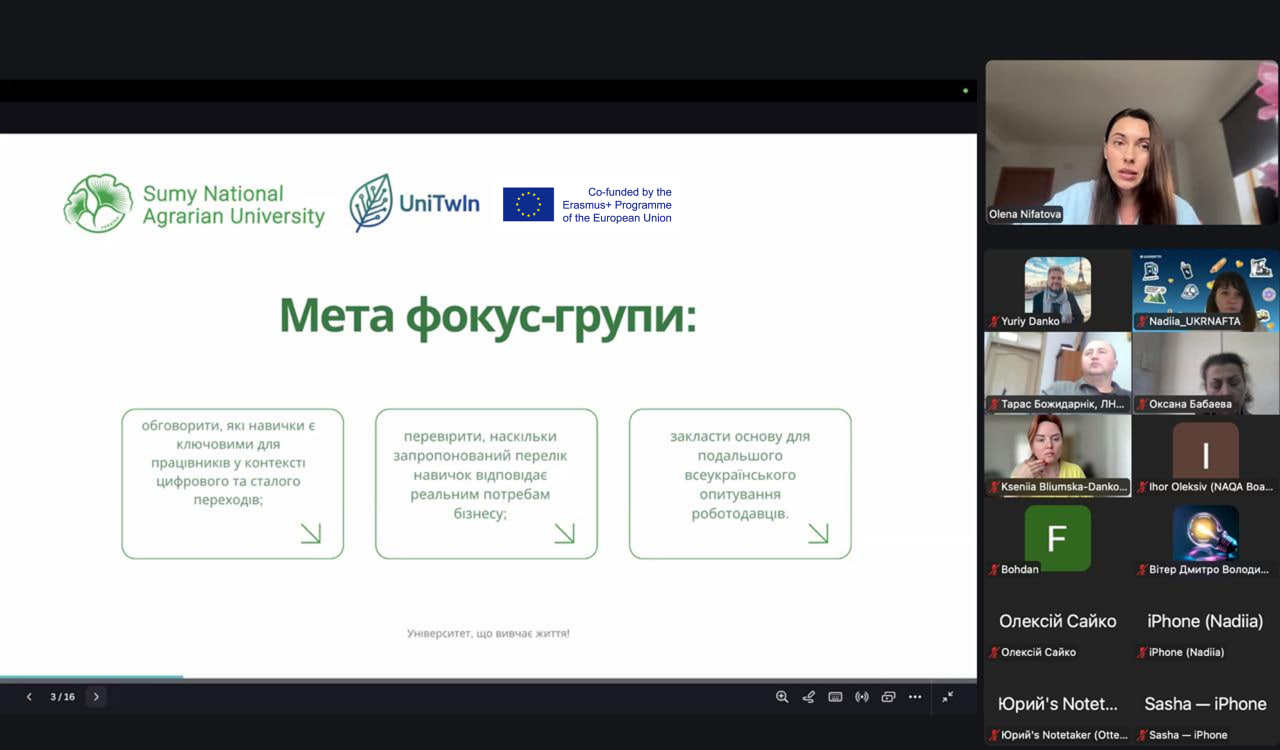
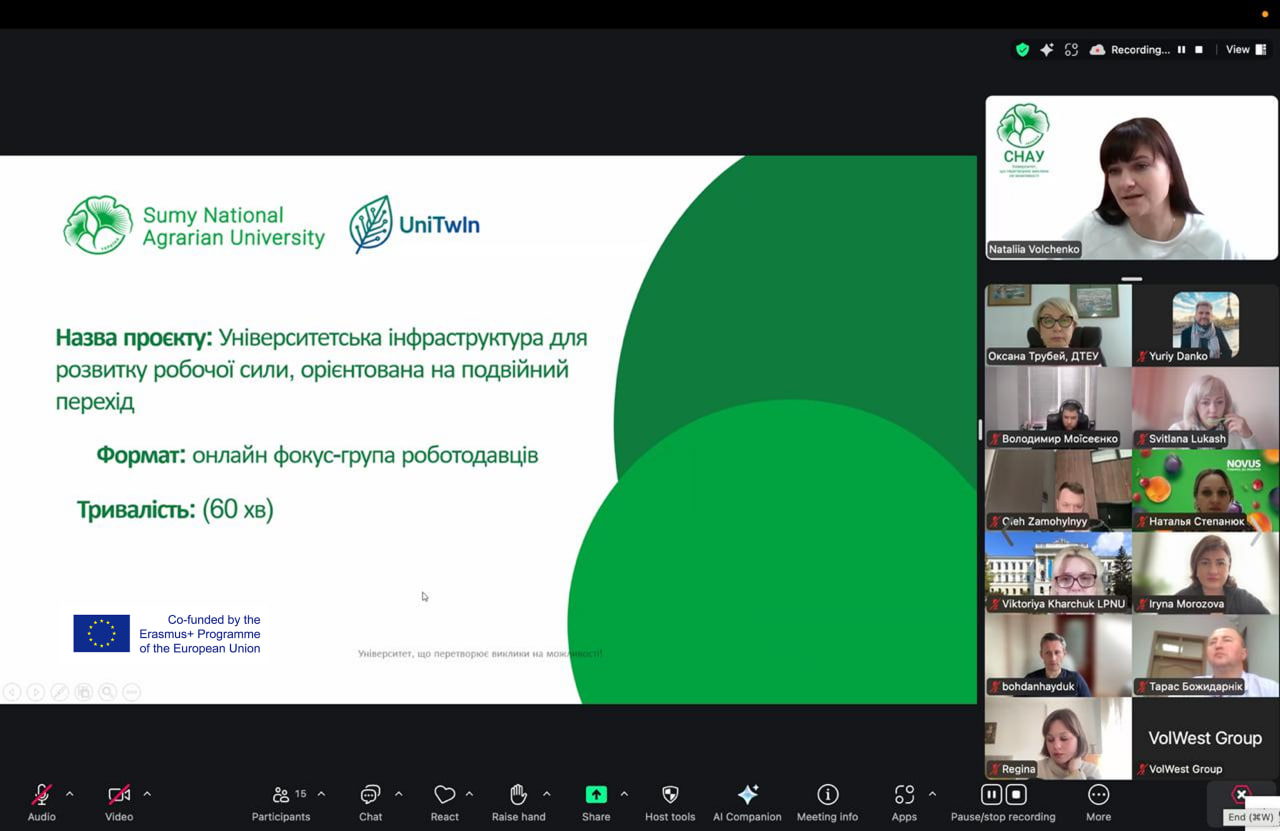
As part of this task, six sectoral focus groups were held, covering the agricultural sector, construction, trade and logistics, information technologies, and energy. Representatives of both large businesses and small and medium-sized enterprises joined the discussions. Among the participants were NOVUS, NIBULON, Kharkiv IT Cluster, RGM Group and others. In total, representatives of more than 30 companies participated in the focus groups, which ensured the representativeness and practical depth of the results obtained.
The discussions focused not only on the current needs of employers, but also on the strategic vision of skills transformation in the coming years. Participants emphasized the growing role of digital technologies in traditional sectors, the need to integrate the principles of sustainable development into business processes, as well as the importance of forming flexible, interdisciplinary competencies.
According to the head of the project group from SNAU, Head of the Research Laboratory of Bioeconomy and Green Marketing Olena Nifatova, the implementation of this work package has a clear scientific and methodological structure:
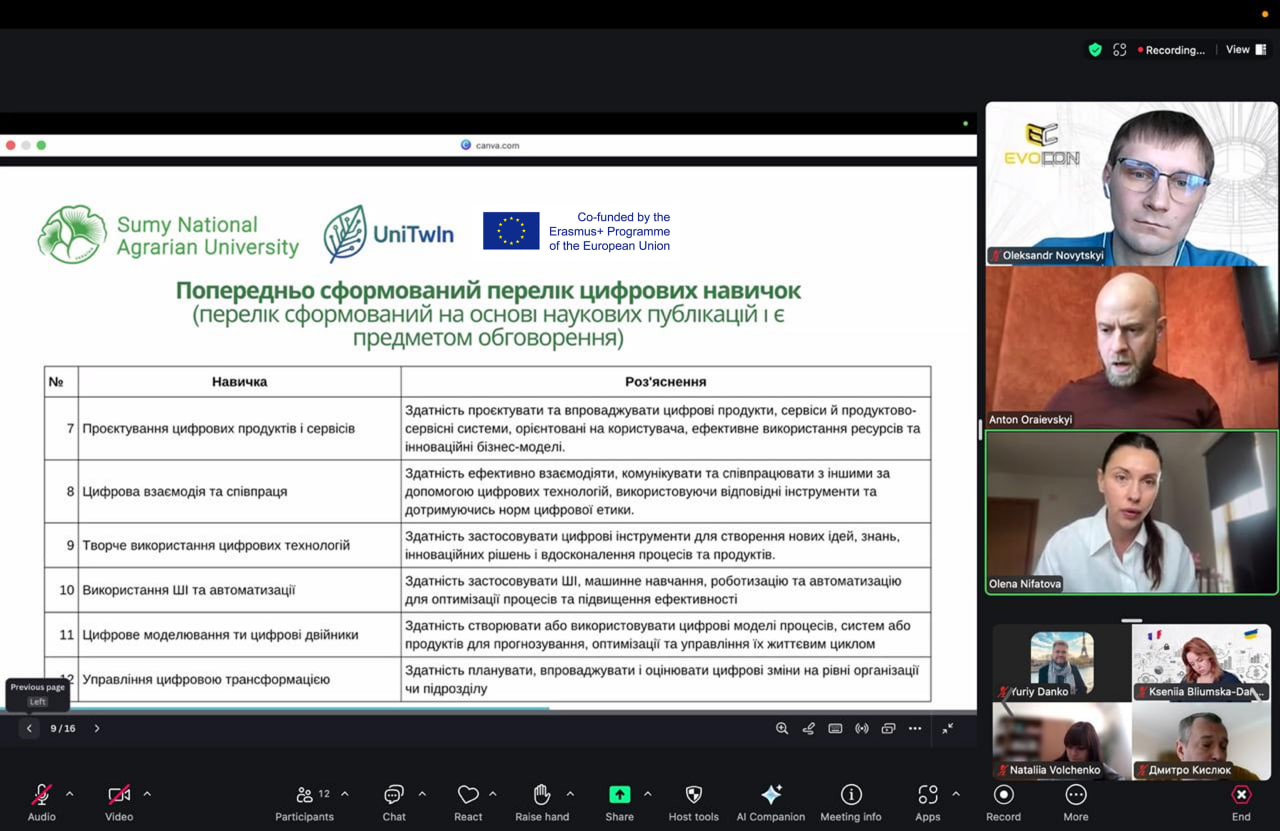
“We work in the logic of consistent research. The first stage is an analysis of modern scientific literature and best international practices, including the achievements of previous projects. Next is qualitative research through focus groups, which allow for a deeper understanding of employers’ expectations. The next step is a large-scale questionnaire survey, which will allow us to quantitatively confirm the results obtained. We consider this process as a full-fledged scientific study with a clear methodology and applied results“.
The work package also includes the formation of a register of stakeholders, the development of a data collection tool, a survey and the preparation of an analytical report on skills needs in the context of Ukraine’s European integration. The final stage will be a joint workshop with the involvement of stakeholders, during which a list of educational courses aimed at developing dual transition competencies in key sectors of the economy will be determined.
Thus, the focus groups conducted are not a separate activity, but an important component of a comprehensive study implemented by an international consortium. They lay the foundation for the formation of new educational approaches, in which universities act as platforms for co-creation of knowledge together with business and other stakeholders.
Sumy National Agrarian University, implementing a responsible methodological block within UniTwIn, contributes to the formation of a modern model of interaction between education, science and the labor market, focused on the challenges of digital and green transformation.